


Our People: A Look Back At Miami's Pioneers
Miami is the most maddening, stimulating, life-encouraging city in the world,” wrote Florida’s favorite environmentalist, Marjory Stoneman Douglas. “Nothing human is foreign to it.”
Douglas should know. She lived in and loved South Florida for 83 of her 108 years. When she arrived from Massachusetts in 1915, Miami was already calling itself “The Magic City,” but it was in reality a small, second-rate tourist town with 3,500 residents; sun-blistered, white crushed-rock streets; and one building taller than four stories. Marjory Stoneman Douglas, like most Miamians past and present, came from someplace else to start a new life here.
Early Pioneers
From the beginning of time to our day, our rich subtropical abundance, its sun, sand and beautiful bay have attracted a diverse group of seekers and dreamers. First came the Tequesta people, who found it more than 10,000 years ago and had it all to themselves until the Spanish — men like Juan Ponce de León and Pedro Menéndez de Avilés — claimed it in the 16th century.
In the early 19th century, enterprising wreckers from the Bahamas came to South Florida and the Florida Keys to pick up the remains of an international array of ill-fated ships that crashed onto the treacherous Great Florida Reef. The Bahamians who stayed became South Florida’s first permanent residents.
At about the same time, the Seminoles and Miccosukee Indians, seeking freedom from white man’s encroaching civilization in Georgia and North Florida, arrived in South Florida, along with a group of runaway African American slaves, who found sanctuary with the Seminoles.With this small, polyglot population, it is no wonder that, when the Spanish flag was lowered and the Stars and Stripes raised over Florida in 1821, the United States paid little attention to South Florida. In fact, one government official summed up the nation’s perception with his comment that South Florida was “a place of half-deluged plains, deep morasses, and almost inaccessible forests ... a home or shelter only for beasts, or for men little elevated above beasts.”
The Seminole and Miccosukee Indians, however, got the government’s attention when they refused to leave Florida and fought to stay. Thus, from 1836 until 1858, South Florida was a war zone, and most of its non-Indian residents were soldiers stationed at Fort Dallas, an army outpost on the Miami River. At war’s end, many of the Indians remained in the Everglades. Some of the soldiers and a few other hearty frontiersmen gave South Florida another new, mostly foreign-born, population.
Impact of the Civil War
The outbreak of the U.S. Civil War also had an impact on South Florida life. Although Florida was in the Confederacy, Federal blockaders controlled the South Florida coast, and few people were allowed in or out. At war’s end, one officer described those who remained as being “of all colors, from Yankee to the ebony Congo, all armed, a more motley crew never trod Captain Kidd’s ships … deserters from the Army and Navy of both sides, a mixture of Spanish and Cubans, outlaws and renegades.”
Following the Civil War, the next group of newcomers to discover South Florida were carpetbaggers and homesteaders. Almost all of what would become Greater Miami was available to citizens or would-be citizens in 160-acre bites if the homesteader would live on and cultivate the land for five years or, in the case of state land, purchase it for $1.25 an acre. Those who came, including some former slaves, were an interesting mix.
Coconut Grove’s First Settlers
South Florida’s first real community began in Coconut Grove when Charles and Isabella Peacock, who came from England, opened a hotel in 1884. Coconut Grove soon attracted a variety of people: Northern intellectuals, European nobility, American industrial magnates, displaced Southerners, as well as Bahamian fishermen. Black Bahamians established the settlement called Kebo in Coconut Grove, the remnants of which are still visible today on historic Charles Avenue.
Julia Tuttle’s Leadership and Henry Flagler’s Railroad
Although Coconut Grove was developing rapidly, along with Lemon City in today’s northeast Miami, the land that would become Downtown Miami had experienced little change from the time of the Spanish. This was soon to change after a feisty Cleveland widow named Julia Tuttle purchased 640 acres on the north bank of the river in 1891 and moved her family into the abandoned Fort Dallas buildings. Within four years, she had convinced Standard Oil co-founder Henry Flagler to extend his railroad to Miami, build a luxury hotel, and lay out a new town.
The railroad arrived in April 1896, the City of Miami was incorporated in July, and the first tourist season was inaugurated in January 1897 with the opening of Flagler’s fabulous Royal Palm Hotel. That same year, the city brought in its first convention, the International Tobacco Growers Association, and set its future as a town built to please the tourists.
Tuttle, however, saw Miami’s future as more than just a tourists’ mecca. She envisioned a major gateway city that would become a center of international trade and commerce. Before the turn of the century, Flagler’s steamships were running between Miami and Nassau and among Miami, Key West and Havana, beginning a cruise industry that today has made Greater Miami and the Beaches the “Cruise Capital of the World.”
As soon as the railroad arrived, the South Florida wilderness came to life as if by magic, and all kinds of people flocked to the rawboned new city. These early Miamians were a variegated lot but with a predominant Southern streak. Even though “Mi-am-a” had a Southern accent, it was never your ordinary Southern town.
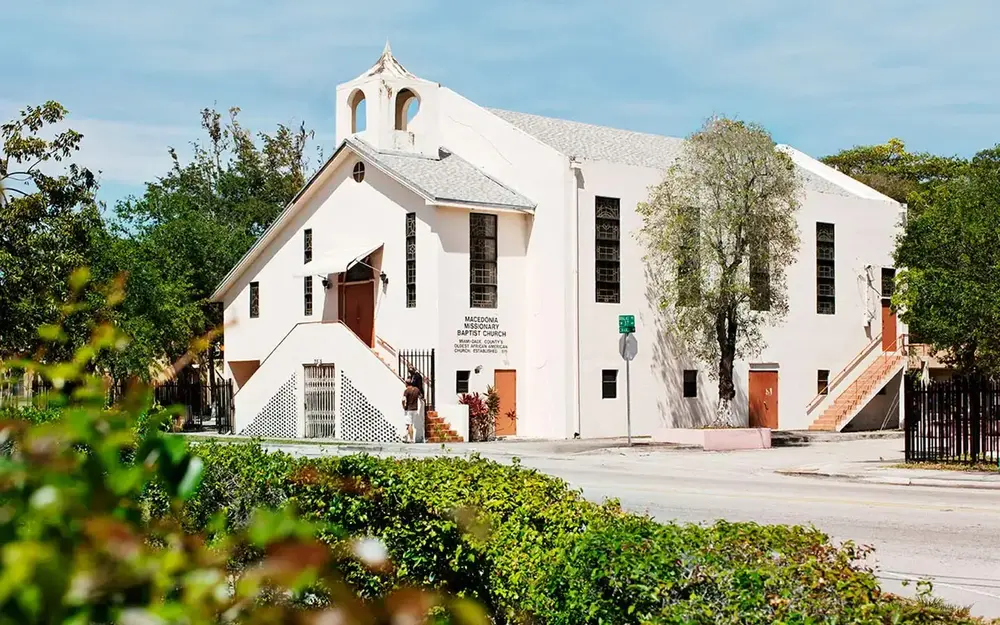
Miami’s first mayor was an Irish Catholic, most of the merchants were Jewish, and Blacks made up one-third of the city’s incorporators, even though they were forced to live in a separate part of town known as “Colored Town.”
Early Visionaries
Miami never lacked for visionaries. One such dreamer was John Collins, a New Jersey Quaker, who embarked on an agricultural venture on a spit of ocean-front beach and started a causeway across the bay to link the beach to the mainland. Joined by Prest-O-Lite king Carl Fisher, the bridge opened in 1913, and the transformation of mangrove coast and avocado grove into Miami Beach began.
At about the same time, Geder Walker, an African American, built the Lyric Theater as the center of the cultural activities on Northwest 2nd Avenue, Miami’s “Little Broadway.” By 1925, the area that became known as Overtown had a thriving business district and several hotels, including the Mary Elizabeth, later joined by the Calvert and Sir John.
The 1920s brought the Great Boom, and Greater Miami and the Beaches’ population quadrupled in only four years. George Merrick, who came to South Florida with his parents from Massachusetts, developed a planned Mediterranean-themed suburb called Coral Gables on his family’s grapefruit plantation.
Other Boom-time themed cities included the fantasy dream of Scheherazade — Opa-Locka — developed by legendary aviator Glenn Curtiss.
Depression Era Leaders
When the bust came after the great hurricane of 1926, South Florida plunged into a deep depression ahead of the rest of the nation. The Depression, however, didn’t stop Pan American Airways from launching its “Flying Clippers” from Miami’s Dinner Key, now Miami City Hall.
The airline advertised Miami as the “Gateway to the Americas,” which in fact it was becoming. Pan Am brought in large numbers of Latin American tourists, as well as a variety of deposed Latin American leaders.
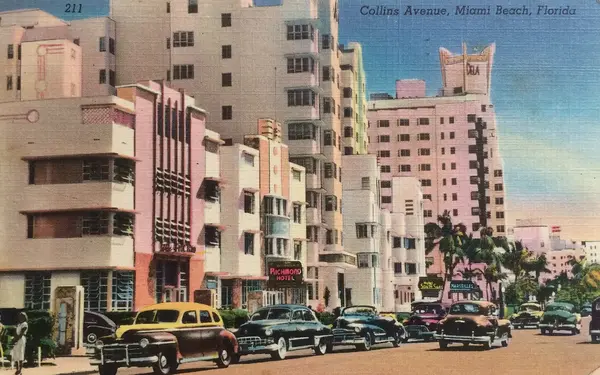
During the Depression, a new group that was predominantly Jewish came to Miami Beach and built a large number of small hotels and apartment buildings with stark “streamline moderne” lines along lower Collins Avenue and Ocean Drive. This building boom helped bring South Florida out of the Depression and, 40 years later, these distinctive hotels became the nucleus of the Art Deco District.
World War II Population Boom
World War II brought another hundred thousand new people into South Florida when the Army Air Corps took over Miami Beach and the Navy took over Miami as major training centers. Many soldiers returned after the war to make South Florida their permanent home. By the end of the 1950s, Miami had doubled its pre-war population.
Cuban Exiles in Miami
When Fidel Castro took over Cuba in 1959, no one dreamed that the revolution would change Miami as much as it changed Cuba. Miamians didn’t know it yet, but the Cuban exiles, who were just beginning to pour into the area, were bringing the next Miami with them.
Even by South Florida standards, the 1960s and 1970s brought mind-boggling change as more than a half-million Cuban exiles fled to Miami to start a new life. These enterprising refugees were the catalysts who launched Greater Miami into its future as an international city and the “Capital of Latin America.”
Ever-changing Skyline
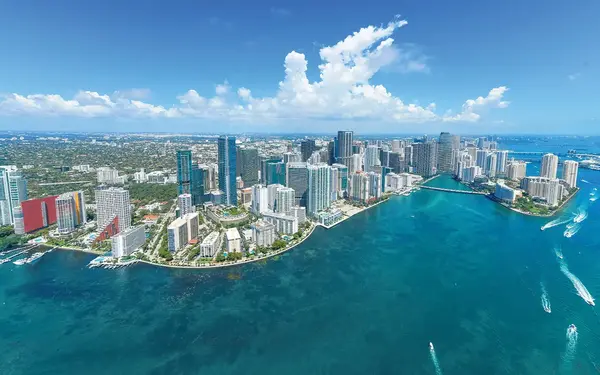
The 1980s brought a beautiful new skyline and a new way of life to Greater Miami and the Beaches. Although Miami had changed almost beyond recognition, the new Miami had thrived amid change and overcome many difficulties. We entered the 1990s alive and beautiful and full of promise. Off we went, unafraid, believing in a different kind of future that would surpass the wildest dreams of its most visionary pioneers.
Now no longer at the end of something, we have become the center of everything — the connector of the Americas, the center of the New World. Today is Miami is rapidly emerging as a world-class, 21st-century city.
Miami's History & Heritage
History of the Miccosukee Tribe
Miami’s Tributes To Dr. Martin Luther King Jr.
History of Miami Beach Through Photos of "Then & Now"
The History of Liberty Square
Art of Black Miami Spotlight
The Most Architecturally Significant Buildings In Downtown Miami